
Digital Product Passport Data Gaps: What SMEs Must Fix Before the EU DPP Registry
Most DPPs fail not at the QR but at the catalogue. Learn the JRC essential vs recommended tiers and how AICA Atlas fixes classification before Hoken Pass publishes your passport page with a QR code.
A Digital Product Passport is only as good as the data behind it. That line from AICA Data captures the risk most SMEs face as the EU DPP rules go live. The EU DPP Registry went live on 20 July 2026, and from 18 February 2027 every EV, LMT and industrial battery over 2 kWh placed on the EU market needs a battery passport under Regulation (EU) 2023/1542. Under ESPR (EU) 2024/1781, textiles, iron and steel and other groups follow with product-specific delegated acts. A quick QR means little if the catalogue behind it is still incomplete.
Digital product passport software for SMEs starts before the passport
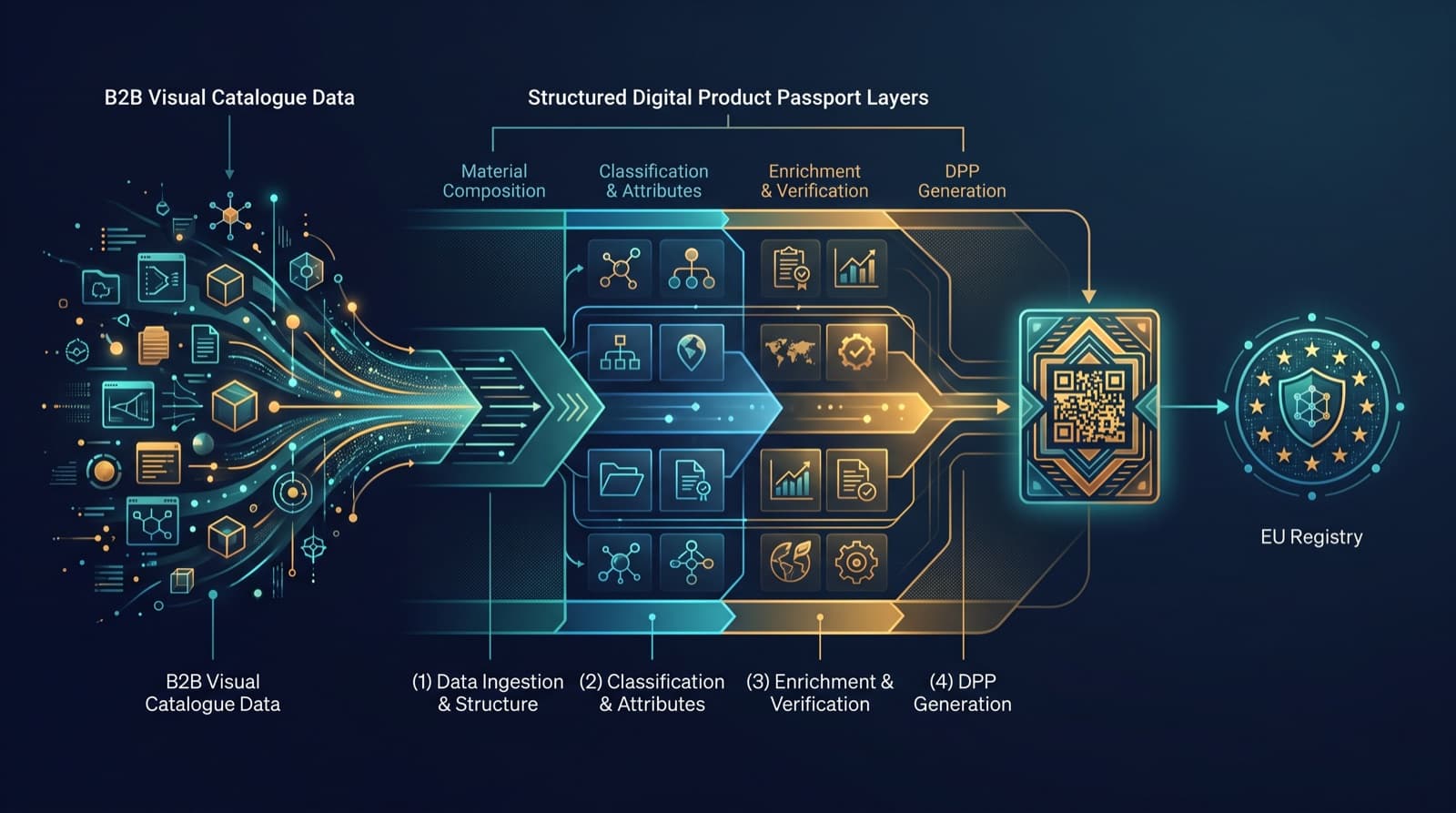
Most catalogues hold enough description for purchasing but not for a passport. Product information lives in ERP, PIM, supplier feeds and PDFs, each with different names and structures. Classification answers what the item is and how it groups. Enrichment adds the supporting details that a DPP needs: materials, dimensions, identifiers, certifications, and provenance. Gaps in either block the passport.
AICA positions its Atlas engine in that space before the passport platform. It classifies and enriches against UNSPSC, eCl@ss, ETIM, GS1 GPC and HS, assigns a reliability score and audit trail, and routes low-confidence records to human review. Atlas connects to SAP, Oracle, Maximo, Coupa, PIM and MDM and can be consumed via API, self-service, white label or AWS Marketplace.
EU ESPR compliance platform and the JRC145830 tiers
On 19 March 2026 the JRC published the methodology for defining DPP data requirements under the ESPR framework (JRC145830). It classifies every candidate field into three tiers based on value, effort and feasibility:
- Essential: required by regulation or strictly necessary for the legal purpose. Missing means the DPP is incomplete.
- Strongly recommended: high policy value and reasonable collection effort given current readiness. Prepare now, even if not yet mandatory.
- Voluntary: useful in niche contexts, low feasibility at scale. Strategic choice, not compliance.
The methodology also ties each field to granularity: model level (one passport per model), batch level (per production batch) and item level (per unit, with unique serialisation). The Battery Regulation already mandates item-level for EV and industrial batteries above 2 kWh. The more granular the level, the higher the serialisation and IT cost, but also the stronger the circular value for repair, reuse and recycling.
Access rights are a separate governance layer. A DPP is not one public page. Delegated acts will define who sees what: consumers see scores and care, repairers see dismantling, recyclers see composition, authorities see full documentation.
How AICA Atlas closes the gap in practice
AICA reports 95.2% first-choice accuracy for UNSPSC version 26 on an MRO test set excluded from training, and at least 40% improvement in attribute completeness. In one project Atlas classified more than 325,000 SKUs for a global IT solutions provider, isolating low-confidence records for expert review. The same reliability scoring and audit trail used for MRO is applied to catalogues prepared for DPP use.
The workflow mirrors what the JRC describes as best practice: assess current classification status with a sample, compare before and after, identify coverage gaps against relevant standards, and plan supplier data collection where attributes are missing. A free sample assessment is offered on aicadata.com.
Why a 5-minute PDF upload is not enough
Tools that generate a passport from uploaded PDFs in minutes solve the last mile: assembling a hosted record and a GS1 Digital Link QR with 15 years of revision-proof storage. That helps SMEs who lack IT capacity. It does not solve classification errors at the source. If an item is tagged to the wrong UNSPSC or eCl@ss, or if recycled content or substance data is absent, the passport carries the error forward. The JRC value-effort assessment shows that moving from model to item granularity or adding composition granularity where it does not already exist can sharply raise cost. Cleaning the catalogue before generating the passport keeps later fixes smaller.
For Hoken Pass, our digital product passport software for SMEs, the order is similar. Classification and supplier evidence stay with your team. Hoken Pass gives you a guided template per product group with the required fields, publishes the passport as a hosted, versioned public page with a QR code, and exports the EU DPP Registry batch file (EU JSON or EU XML) for you to upload when your product group becomes mandatory. Every published version carries a qualified eIDAS timestamp from InfoCert, on every plan including Free, and from the Base plan also a blockchain record (EOS) for auditability, with eIDAS providing legal validity and blockchain providing evidence, not the other way around.
eIDAS timestamp and blockchain auditability behind the data
European trust for regulated documents sits on eIDAS qualified timestamps and seals, not on a ledger alone. A qualified eIDAS timestamp proves that data existed at a point in time and has not changed. Anchoring the hash on a blockchain adds immutable evidence that the timestamped record was later published and can be verified by any party. Hoken Pass applies the timestamp to every published version, adds the blockchain record from the Base plan and keeps version history, so a battery passport updated with new state-of-health still carries verifiable lineage. This matters once delegated acts require tiered access and long retention.
What SMEs should prepare now
- Map essential fields for your category: check the Battery Regulation for batteries and the ESPR working plan for your next category. Note the granularity your delegated act will require.
- Locate each field: your ERP or PIM, your supplier, or to be calculated (for example product carbon footprint). Expect supplier lead times of months.
- Prioritise composition and footprint early: these score high in the JRC assessment and depend on upstream data.
- Validate schema before publishing: run the data through a compliance engine and keep source document, approver and timestamp per field.
A single product pilot is enough to surface the gaps. The sample assessment pattern that AICA uses translates directly: one model, full classification check, then plan the rest.
Frequently asked questions
What are digital product passport data gaps? They are missing or inconsistent classifications and attributes in the catalogue that a DPP requires. Typical gaps are wrong UNSPSC or eCl@ss codes, missing material composition, missing recycled content share, and missing provenance for critical raw materials. A passport built on such gaps is incomplete.
Which DPP data is mandatory for SMEs? Essential data defined by the applicable regulation and delegated act for your product group. For batteries the Battery Regulation defines the list. For other ESPR groups no delegated act has been adopted yet, so the JRC tiers help you separate what must be ready now from what is strongly recommended.
How does the JRC145830 methodology help my team? It gives a repeatable value versus effort scoring and three tiers, plus guidance on model, batch and item granularity. Use it to decide where to invest first and to align internal vocabulary choices before you build the passport.
Does Hoken Pass fix catalogue data for me? No. Hoken Pass gives you a guided template per product group with the required fields, then publishes the passport as a hosted, versioned page with a QR code, with a qualified eIDAS timestamp on every published version and, from the Base plan, a blockchain record for the audit trail. Classification and supplier evidence stay with your company.
Sources
- AICA Data Addresses Data Gaps for EU Digital Product Passports - EIN Presswire
- JRC145830 Methodology for defining data requirements for the DPP under ESPR - PDF
- Digital Product Passport - European Commission DG GROW
- Regulation (EU) 2023/1542 on batteries - EUR-Lex
- Regulation (EU) 2024/1781 ESPR - EUR-Lex
- eIDAS Trust Services - eideasy.com
- SwissTrustLayer eIDAS Timestamp Services