
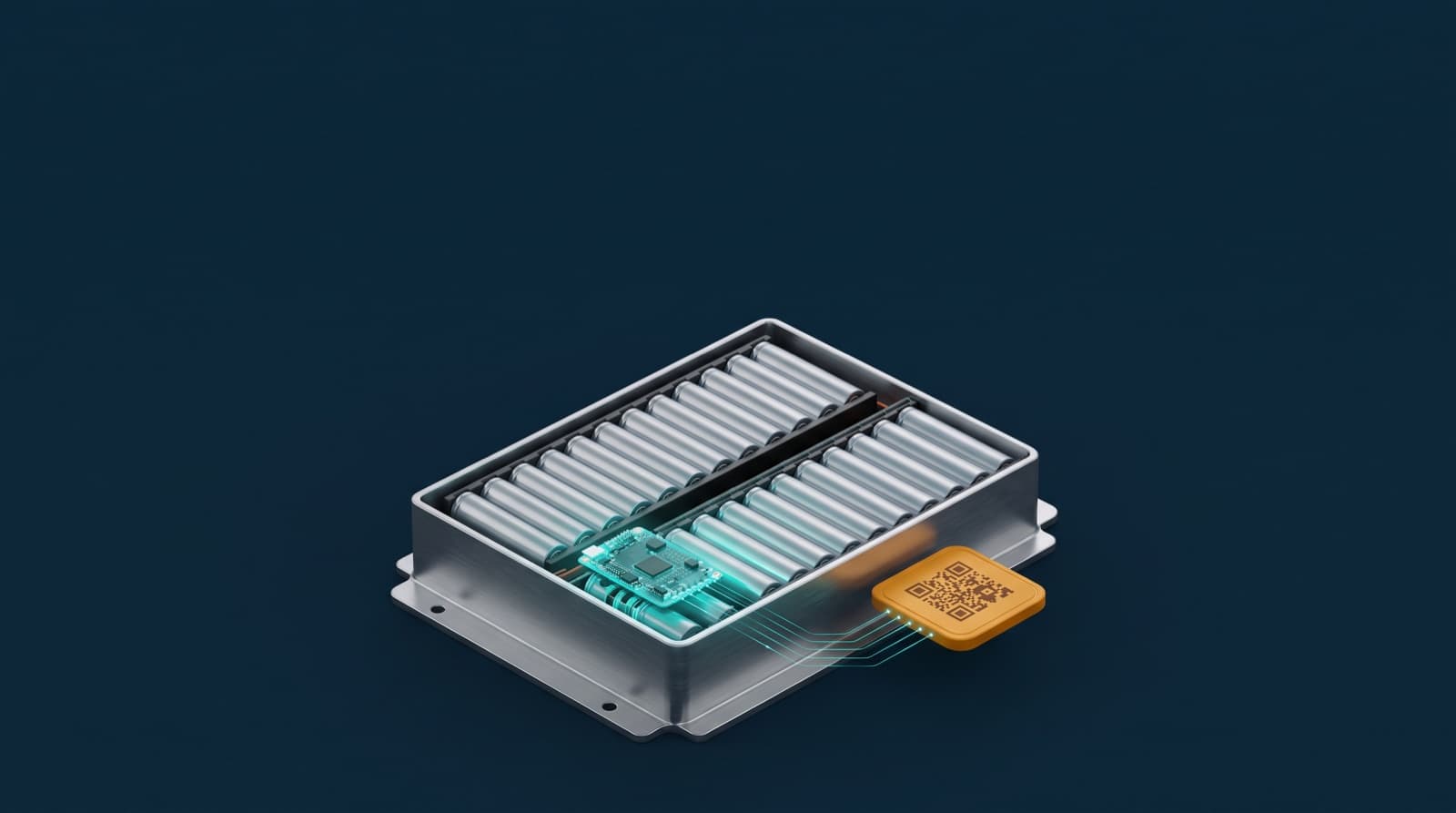
Does Every Battery Cell Need a Passport? One Passport per Battery, and Where Cell Data Goes
The EU battery passport is issued per battery, not per cell. Cells appear as model data in Annex XIII, while state of health and use data come from the battery management system. What Article 77 and the Commission's battery FAQ say, before 18 February 2027.
From 18 February 2027, EV batteries, LMT batteries and industrial batteries above 2 kWh placed on the EU market need a battery passport. For companies that assemble packs, the next question is how deep that passport has to go. Does every cell inside the pack need its own record and its own identifier?
The question got louder last week. On 23 October 2026, Battery Technology published an article by a senior director at a company that makes cell monitoring hardware, arguing that the EU battery passport drives traceability down to the cell. The same article acknowledges that many OEMs are still laying the groundwork for compliance at pack level.
Does every battery cell need a battery passport?
No. Article 77(1) of Regulation (EU) 2023/1542 says that from 18 February 2027 "each LMT battery, each industrial battery with a capacity greater than 2 kWh and each electric vehicle battery placed on the market or put into service shall have an electronic record ('battery passport')."
The unit is the battery. The regulation defines a battery as a device "consisting of one or more non-rechargeable or rechargeable battery cells, modules or of packs of them" (Article 3(1)). A cell is "the basic functional unit in a battery" (Article 3(4)). So cells and modules are parts of the battery that carries the passport.
The Commission's EU Digital Product Passport FAQ for Batteries (1st edition, September 2026) confirms this from the supply chain side: imported cells or modules that are components to be assembled into a finished battery in the EU are not themselves treated as the finished battery. We covered who carries the obligation in that case in who is responsible for the EU battery passport.
One unique identifier per battery
Article 77(3) sets how the passport is reached: through the QR code referred to in Article 13(6), "which links to a unique identifier that the economic operator placing the battery on the market shall attribute to it." The QR code and the identifier must comply with the ISO/IEC 15459 standards or their equivalent.
So the regulation asks for one unique identifier per battery. Nothing in Article 77 requires an identifier for each cell.
Where cell information goes in the battery passport
Cells do appear in the passport, as information about the battery model. A battery model is "a version of a battery all units of which share the same technical characteristics" and the same model identifier (Article 3(19)).
Annex XIII splits the passport content into four groups. The cell related items sit in the model groups:
| Data in the passport | Level | Who can see it | Annex XIII |
|---|---|---|---|
| Material composition, chemistry, hazardous substances, critical raw materials | Battery model | Public | Point 1(b) |
| Detailed composition, including materials used in the cathode, anode and electrolyte | Battery model | Persons with a legitimate interest and the Commission | Point 2(a) |
| Exploded diagrams showing the location of battery cells, amount of cells used and layout | Battery model | Persons with a legitimate interest and the Commission | Point 2(c) |
| State of health, status, cycles, negative events, temperature, state of charge | Individual battery | Persons with a legitimate interest | Point 4 |
In practice, the cell data you need is the data in your cell supplier's datasheet and material declarations, entered once per battery model. Our article on battery passport supplier data covers how to ask suppliers for it.
The individual data comes from the battery management system
Point 4 of Annex XIII lists the data about each individual battery:
- the values for the performance and durability parameters of Article 10(1), when the battery is placed on the market and when its status changes;
- information on the state of health, pursuant to Article 14;
- the status of the battery: original, repurposed, re-used, remanufactured or waste;
- data resulting from its use, "including the number of charging and discharging cycles and negative events, such as accidents", plus periodically recorded operating temperature and state of charge.
Most of this is what a battery management system already measures and stores. The regulation defines the BMS as the device that controls the battery's electric and thermal functions and "manages and stores the data for the parameters for determining the battery's state of health" (Article 3(25)).
The FAQ adds two limits. State of health requirements apply only where the battery has a BMS (question 8.5). Use related data under point 4(d) has no such exemption. And when a new battery is first placed on the market, data generated during its life does not exist yet, so those fields may start empty (question 8.6). The status and the performance and durability values are the exception: they are due from day one.
How often must dynamic data be updated?
The FAQ says that at a minimum, dynamic data must be updated "when a change in the battery's status occurs or is being considered", for example when deciding whether to remanufacture, repurpose or recycle it (question 8.3). More frequent updates may be needed where the state of health has to be monitored, "if technically feasible and proportionate", but if it does not change materially from week to week, weekly updates are not necessary.
Real time communication is not necessarily required (question 8.4). For an offline e-bike battery, updating the passport when the battery is brought in for servicing "seems appropriate" (question 8.7).
Repairs, remanufacturing and new passports
A simple repair does not require a new battery passport (FAQ question 9.2). A battery that is repurposed or remanufactured, or prepared for re-use after becoming waste, gets a new passport, normally under a new economic operator (question 9.1). Article 77(7) adds that the new passport is "linked to the battery passport or passports of the original battery or batteries." When the battery is recycled, the passport ceases to exist (Article 77(8)).
The link runs from battery passport to battery passport. Our article on the battery passport second-life gap covers what second life operators need from it.
Is cell level traceability worth it?
It can be. Per cell monitoring can give more precise diagnostics and better information for reuse and recycling, which is the case the Battery Technology article makes. But it is an engineering and business choice, not a legal requirement of the battery passport. For a small company that assembles packs for e-bikes, scooters or storage, the legal minimum sits at battery level, and that is where the work should start.
What to do before 18 February 2027
- Give every battery a unique identifier. Decide the format now, in line with the ISO/IEC 15459 standards named in Article 77(3), and plan how the QR code required by Article 13(6) links to it.
- Collect model data from your cell and module suppliers: cathode, anode and electrolyte materials, chemistry, hazardous substances and critical raw materials, plus your own pack drawings with the cell count and layout. Our guide to how many battery passport data points are mandatory helps you sort what is due on day one.
- Check what your BMS can export: state of health, cycle count, negative events, temperature and state of charge. If the battery is offline, plan how a service partner reads the data at each visit.
- Write down who updates the passport after sale. The operator placing the battery on the market stays responsible, but the practical work can be delegated through written authorisation (Article 77(4), FAQ question 8.2).
Hoken Pass is digital product passport software for SMEs with a battery template. Each published passport gets a public page with a QR code and a qualified eIDAS timestamp from InfoCert, and you can start on the free plan with 3 passports. For the full picture of the battery rules, see our EU battery passport page.
Frequently asked questions
Does every battery cell need a battery passport?
No. Article 77(1) of Regulation (EU) 2023/1542 requires a passport for each LMT battery, each industrial battery above 2 kWh and each EV battery. Cells and modules are components of the battery, and the passport belongs to the finished battery.
Does the battery passport need a unique identifier for each cell?
No. Article 77(3) links the QR code to a unique identifier that the economic operator placing the battery on the market attributes to the battery. The regulation does not require identifiers for individual cells.
What information about cells must the battery passport contain?
Model level information: the material composition and chemistry (public), the detailed composition including cathode, anode and electrolyte materials, and dismantling information including the location, amount and layout of cells (for persons with a legitimate interest). See Annex XIII, points 1 and 2.
Does a battery without a BMS need state of health data?
No. The Commission's battery FAQ says state of health requirements apply only where the battery has a BMS. The status of the battery and the performance and durability values are still required, and use related data under Annex XIII point 4(d) has no such exemption.
How often must battery passport data be updated?
There is no fixed frequency. At a minimum, dynamic data must be updated when a change in the battery's status occurs or is being considered. For an offline e-bike battery, the FAQ considers an update at servicing appropriate.
Does replacing parts of a battery require a new passport?
A simple repair does not. A battery that is remanufactured or repurposed needs a new passport, linked to the passport of the original battery.
Sources
- Regulation (EU) 2023/1542 on batteries and waste batteries, Articles 3, 13, 14 and 77 and Annex XIII (EUR-Lex)
- European Commission: EU Digital Product Passport FAQ for Batteries, 1st edition, September 2026
- Battery Technology: EU Battery Passport Drives Cell-Level Traceability Across Electrified Industries (23/10/2026)
Start free with 3 passports: hokenpass.com.