
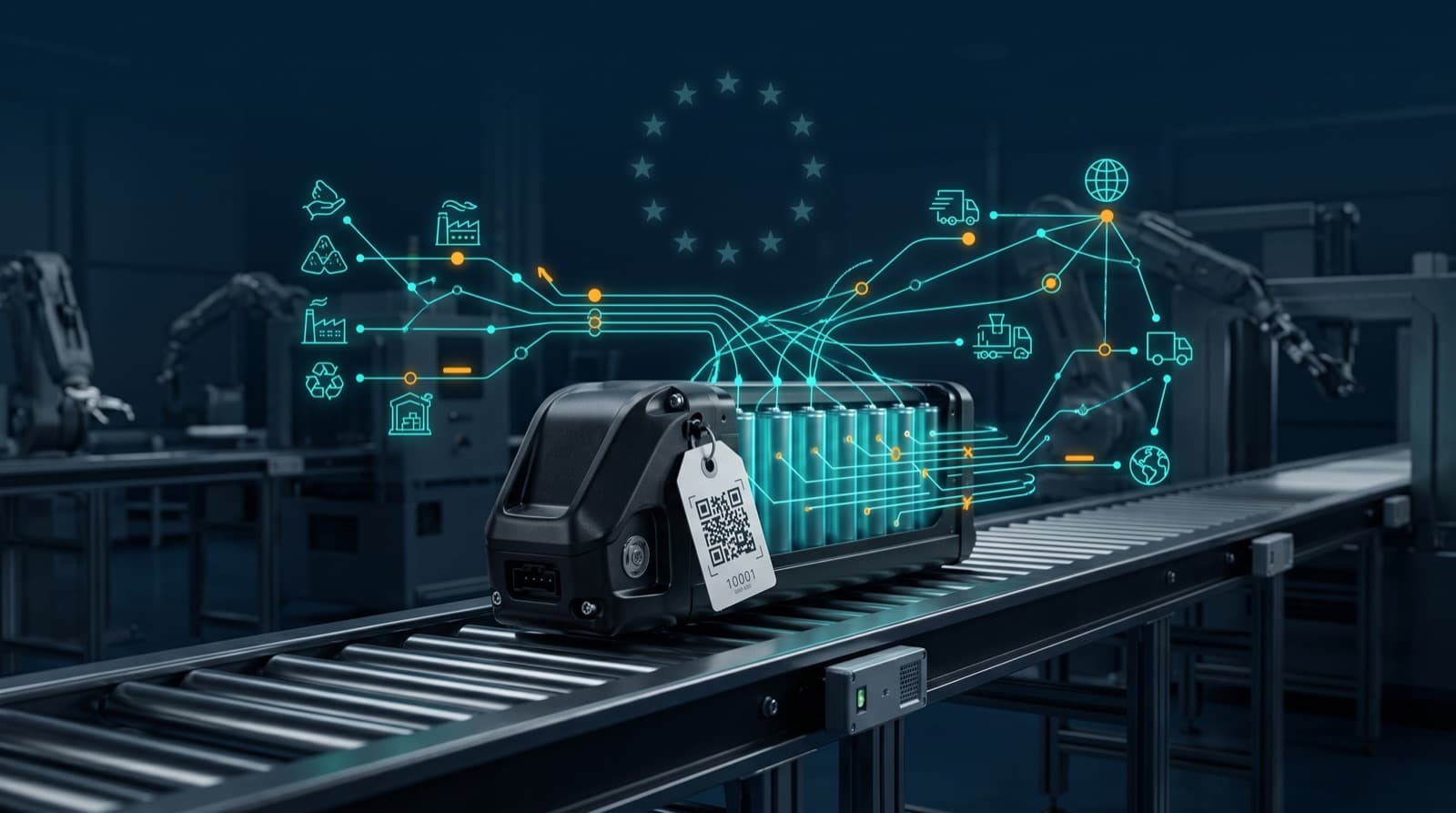
eBike Batteries Need a Passport from 18 February 2027: the TENWAYS Case
TENWAYS with Minespider started issuing battery passports for eBike batteries ahead of the LMT deadline. What the passport must contain, why the QR is the easy part, and the SME checklist.
An eBike maker started issuing battery passports four months before the mandate. That sentence matters more than it looks, because light means of transport are where the battery passport stops being theory and becomes a production routine.
On 7 October 2026, Cycling Industry News reported that eBike brand TENWAYS, working with DPP platform Minespider, developed and implemented Digital Battery Passports for its eBike batteries ahead of the EU Battery Regulation date. This article reads the case with sources, lists what an LMT passport must actually contain, and ends with the checklist a small maker or importer can start this month.
Battery passport: what changes on 18 February 2027
From 18 February 2027, every LMT battery placed on the EU market or put into service needs a battery passport under Article 77 of Regulation (EU) 2023/1542. LMT covers e-bike, e-scooter and e-moped batteries, with no capacity threshold: a 250 Wh city pack is in scope exactly like a large cargo pack. The passport carries model information plus data specific to the individual battery, reachable through a QR code linked to a unique identifier. The regulation asks for information that is accurate, complete, up to date, structured, searchable and interoperable. The Commission's EU battery passport FAQ adds the fine print: a detailed data-points document is published, some fields apply only to certain battery types, and carbon footprint, recycled content and due diligence follow their own application dates.
What TENWAYS actually built
Per the report, TENWAYS began early to put three things in place: supplier engagement, data structures, and digital infrastructure for compliant passports at scale. The implementation with Minespider supports creation and management of the passports and a structured approach to the battery information that travels with each product. TENWAYS Europe GM Amir Fazeli frames it as process work: prepare now, build the right routines into operations, avoid a last-minute compliance exercise. Note the honest division of labour here. TENWAYS chose an external DPP platform for the job. That is normal enterprise behaviour, and it tells SME makers something useful: vendor selection for passports already runs like software procurement, with data flows and supplier onboarding as the selection criteria.
Why the QR is the easy part
The same week, Automotive Manufacturing Solutions published the other half of the story: the passport as a production tool, not a bureaucratic monster. Spherity's Ricky Thiermann puts the gap plainly. Article numbers, bills of materials and batch references exist in companies but sit scattered across systems, and structured collection usually ends at manufacturing or sale. For repair, warranty or remanufacturing, the missing piece is lifecycle data: maintenance, component replacement, software updates. The passport forces systematic collection for the first time, which makes traceability a standard process and recalls more targeted. The article also records the cost warning from the German auto association VDA: reporting duties already push mid-size suppliers to their limits, and the answer is harmonised standards (Catena-X, Asset Administration Shell, DIN DKE SPEC 99100) so tier 2 and tier 3 suppliers stop preparing the same data in several formats. That is exactly the SME gap.
EU ESPR compliance platform: the SME checklist for LMT
An EU ESPR compliance platform worthy of the name does unglamorous work. For an eBike maker or importer, in order:
- Give every pack a persistent identifier and decide model, batch or unit granularity before printing any QR.
- Collect chemistry, carbon, recycled content, due diligence and performance data per batch, with documents attached.
- Clarify who issues the passport: if you import complete bikes with the battery inside, the duty lands on you.
- Version every record and seal it with a qualified electronic timestamp, so market surveillance sees what changed and when.
- Expose the passport through the QR code Article 77 requires and keep an identifier the EU DPP Registry accepts. The Registry is operational since July 2026, holding identifiers while full data stays with the brand or its provider.
Bikes sold in spring 2027 leave factories in 2026. Passport readiness belongs in this year's supplier contracts, not in next year's panic.
How Hoken Pass fits
Hoken Pass is digital product passport software for SMEs, built for the makers the regulation hits without an enterprise traceability team: guided templates per product group with the required fields, a hosted and versioned public passport page with a QR code, a qualified eIDAS timestamp from InfoCert on every published version, and EU DPP Registry batch files in JSON and XML ready to upload. Start free with 3 passports, timestamp included; the Base plan costs 120 euro per year and adds a blockchain record on EOS.
Start free: https://www.hokenpass.com
Frequently asked questions
Do all eBike batteries need a passport from 18 February 2027? Yes. LMT batteries have no capacity threshold: every unit placed on the EU market or put into service from that date needs a battery passport under Article 77 of Regulation (EU) 2023/1542.
Who issues the passport if I import complete eBikes? You do, as the economic operator placing the battery on the market. A supplier may hold most data and may issue passports for packs it placed on the market itself, but accountability for complete imported bikes stays with the importer.
What must the passport contain? Model data plus unit-specific data: identity, chemistry and materials, carbon footprint, recycled content, due diligence, performance and durability, circularity. Some fields apply only to certain battery types or later dates; the Commission FAQ and data-points document define the exact split.
Is the QR code enough? No. The QR on a unique identifier is only the carrier. The regulation requires the underlying data to be accurate, complete, up to date, structured, searchable and interoperable, which means collection systems, not stickers.
Where should an SME start now? Map packs to bikes with persistent identifiers, gather supplier documents per batch, write the service and repair trail into the record, timestamp every version, and expose it all through the QR code on each pack.