
EU Battery Passport Implementation: The New Commission Guidance and What to Do Before February 2027
The European Commission's August 2026 guidance maps all 71 battery passport data points by category. Here is what it requires, what the new DPP Registry means, what DENSO's real-world validation revealed, and how SMEs can prepare before 18 February 2027.
On 21 August 2026 the European Commission published updated implementation guidance for the digital batteries passport. The document lists all 71 data points the passport must carry for electric vehicle, light means of transport, and industrial batteries, and marks each one as mandatory, optional, conditional, or not required as of February 2027.
The timing matters. From 18 February 2027, every battery in these categories placed on the EU market needs a passport. That leaves under six months, and the Commission has now handed companies the exact checklist they will be measured against.
This article walks through what the guidance contains, what the newly launched DPP Registry means for your workflow, what a real-world validation by DENSO revealed about where companies struggle, and what a smaller company can realistically do next.
What the EU battery passport requires, and from when
The requirement comes from Regulation (EU) 2023/1542, the EU Battery Regulation. Article 77 sets out the battery passport obligation. From 18 February 2027, each EV battery, each LMT battery, and each industrial battery with a capacity greater than 2 kWh that is placed on the market or put into service must have a battery passport.
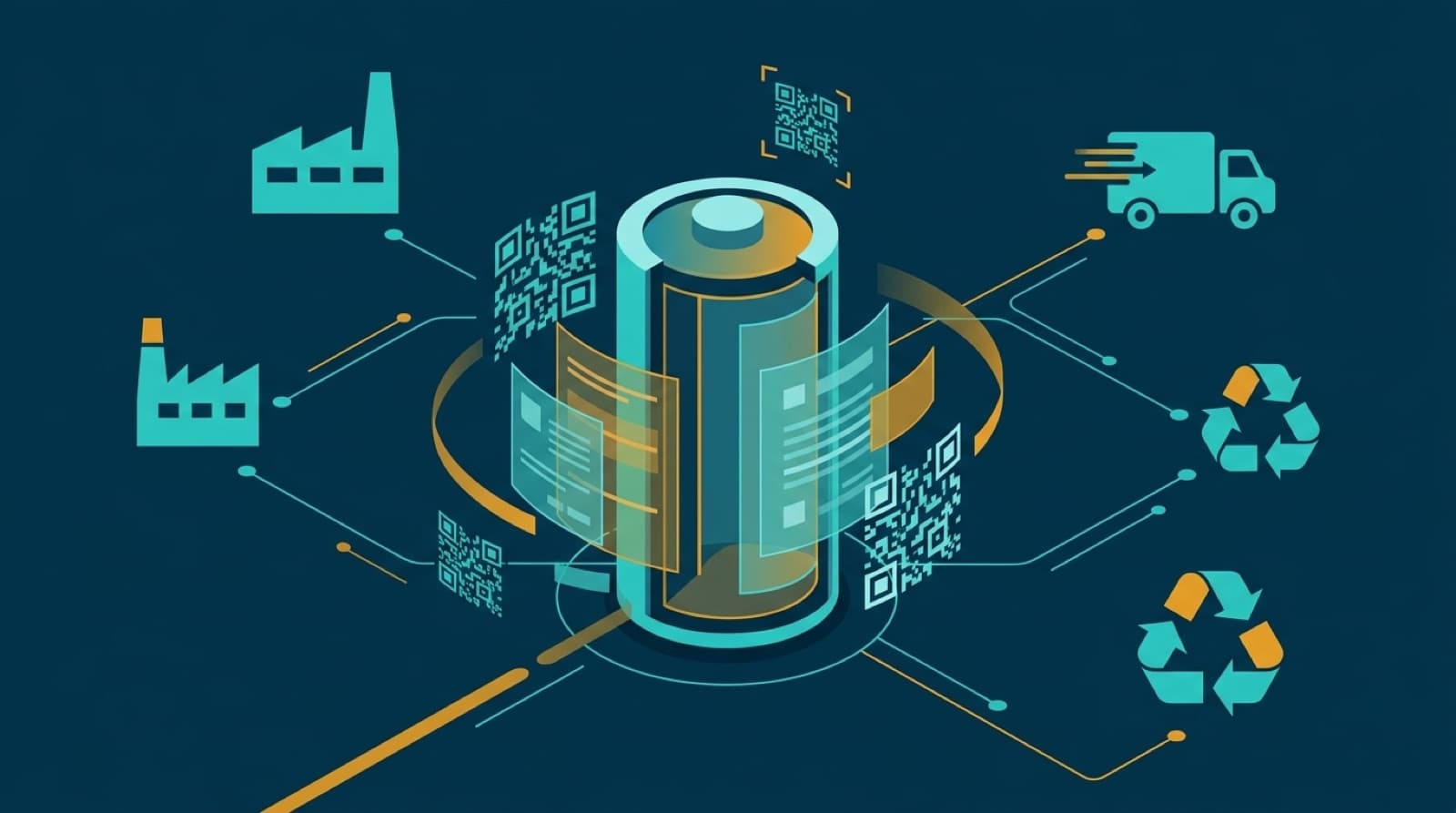
The passport itself works through a QR code linked to the product. Scanning it gives different users different views of the data: consumers see general information, while repairers, recyclers, and authorities access what their role requires. The system is decentralised, which means the responsible economic operator maintains the detailed battery data, not a single central database.
Guidance document: Digital Batteries Passport data points by category
The new guidance document, published as "Digital Batteries Passport - data point by category" (version 2.0, dated 15 August 2026), organises all 71 data points by battery category and shows, for each one:
- whether a data point is mandatory,
- when it applies only in specific circumstances,
- which points do not have to be filled or displayed as of February 2027.
For each data point the guidance also cites its legal source in the Battery Regulation. That last detail is practical rather than decorative: when your team debates whether a field belongs in your data model, the answer is now a lookup instead of an interpretation exercise.
Two limits are worth knowing before you circulate the document internally. First, the Commission states clearly that the guidance introduces no additional legal requirements and is not an authoritative interpretation of the law. Second, the document may evolve: future updates may add definitions, measurement units, or reporting formats. Treat it as the best available working baseline, not as finished law.
The infrastructure is live: the DPP Registry opened in July
Guidance is only half of what changed this summer. On 20 July 2026 the Commission launched the Digital Product Passport Registry together with a testing environment. The Registry is where every passport gets registered before a covered product goes on the market: it stores unique identifiers, the location of each passport, and associated metadata so authorities and market participants can find and verify them.
Alongside the Registry, six of eight harmonised standards developed with CEN-CENELEC are already published, covering identifiers, interoperability, data carriers, APIs, data exchange protocols, and data storage. An implementing act covering battery passport access rights is on the Commission roadmap for Q4 2026.
The practical consequence: you can already test registration workflows today, against real infrastructure, months before enforcement starts. Companies that wait until January will be building their data pipeline and learning the Registry at the same time, under deadline pressure.
DENSO's real-world validation shows where companies struggle
Regulatory documents tell you what must exist. They say little about what it takes to produce it. For that, the June 2026 validation by DENSO is instructive.
DENSO built a battery passport service compliant with the EU Battery Regulation and tested it using actual production data from AESC's energy storage batteries intended for the European market. TÜV Rheinland Japan acted as third-party verifier, checking the data handling against the Regulation and DIN DKE SPEC 99100, the German standard defining digital battery passport data attributes, including mandatory items such as manufacturer information, material composition, and CO₂ footprint. The service generates a passport per product and controls access through role-based permissions behind a QR code.
The result worth reading twice: the validation surfaced difficulties in data preparation and day-to-day operations, not in the technology. Generating the passport was workable. Collecting consistent, current data across suppliers and business processes was the hard part, even for a tier-one supplier with dedicated teams.
If data preparation is the bottleneck at DENSO's scale, it is reasonable to assume smaller manufacturers feel the same squeeze with fewer resources.
What SMEs should do now
You do not need an enterprise program to start. A realistic sequence for the next few weeks:
Read the guidance once end to end. Download the data point document from the Commission website and filter it for your battery category. Depending on what you produce, a share of the 71 points will not apply to you at all, which shrinks the problem considerably.
Assign ownership early. Each data point has a natural owner somewhere in your organisation or supply chain: chemistry data sits with engineering, carbon footprint figures with suppliers, recycling information with compliance. Unowned data points stay empty.
Start with one product. A pilot on a single battery model surfaces every gap in supplier data, internal systems, and registry workflows while the stakes are low. Scaling later is incremental work. Discovering gaps in January is a crisis.
Pick tooling that fits your size. Enterprise platforms assume enterprise teams. Self-service digital product passport software for SMEs and similar tools let you create a compliant passport record, apply a qualified eIDAS timestamp for legal validity, and anchor records to blockchain for immutability and auditability without a multi-year project. The eIDAS timestamp is what makes your records legally defensible; the blockchain layer makes tampering provable. You want both, explained plainly rather than sold hard.
Frequently asked questions
When do battery passports become mandatory? 18 February 2027. From that date, EV batteries, LMT batteries, and industrial batteries above 2 kWh placed on the EU market or put into service require a passport.
Which batteries are covered? Electric vehicle batteries, light means of transport batteries, and industrial batteries with capacity greater than 2 kWh. Portable batteries are outside the passport requirement.
Is the Commission's August 2026 guidance legally binding? No. The Commission states the guidance introduces no additional legal requirements and is not an authoritative interpretation. It is a practical working document that may still be updated.
Where can I download the Digital Batteries Passport data points guidance document? The PDF "Digital Batteries Passport - data point by category" is on the European Commission's website, linked from the EU Digital Product Passport FAQ for Batteries page. The direct link is in the sources below.
What is the EU DPP Registry? It is the central EU database, live since 20 July 2026, where digital product passports are registered. Product data stays with the economic operator; the Registry stores identifiers, passport locations, and metadata so passports can be found and verified. A testing environment is open now.
Sources
- European Commission: Guidance to support preparations for the Digital Batteries Passport (21 August 2026)
- European Commission: Guidance Document, Digital Batteries Passport, data points by category (v2.0, 15 August 2026)
- European Commission: The Digital Product Passport Registry is now live (20 July 2026)
- DENSO: DENSO and TÜV Rheinland Japan confirm the practicality of battery passport for AESC's energy storage product using actual data (29 June 2026)
- EUR-Lex: Regulation (EU) 2023/1542 on batteries and waste batteries
- European Commission: Digital Product Passport policy page
- European Commission: EU Digital Product Passport FAQ for Batteries (1st edition, September 2026)
Related: battery passport data points: how many are mandatory in February 2027 and who is responsible for the EU battery passport.
Getting your product data ready is the part that takes time. Hoken Pass gives you self-service digital product passports with qualified eIDAS timestamps and blockchain anchoring, starting from a single pilot product.
Start free with 3 passports: hokenpass.com.