
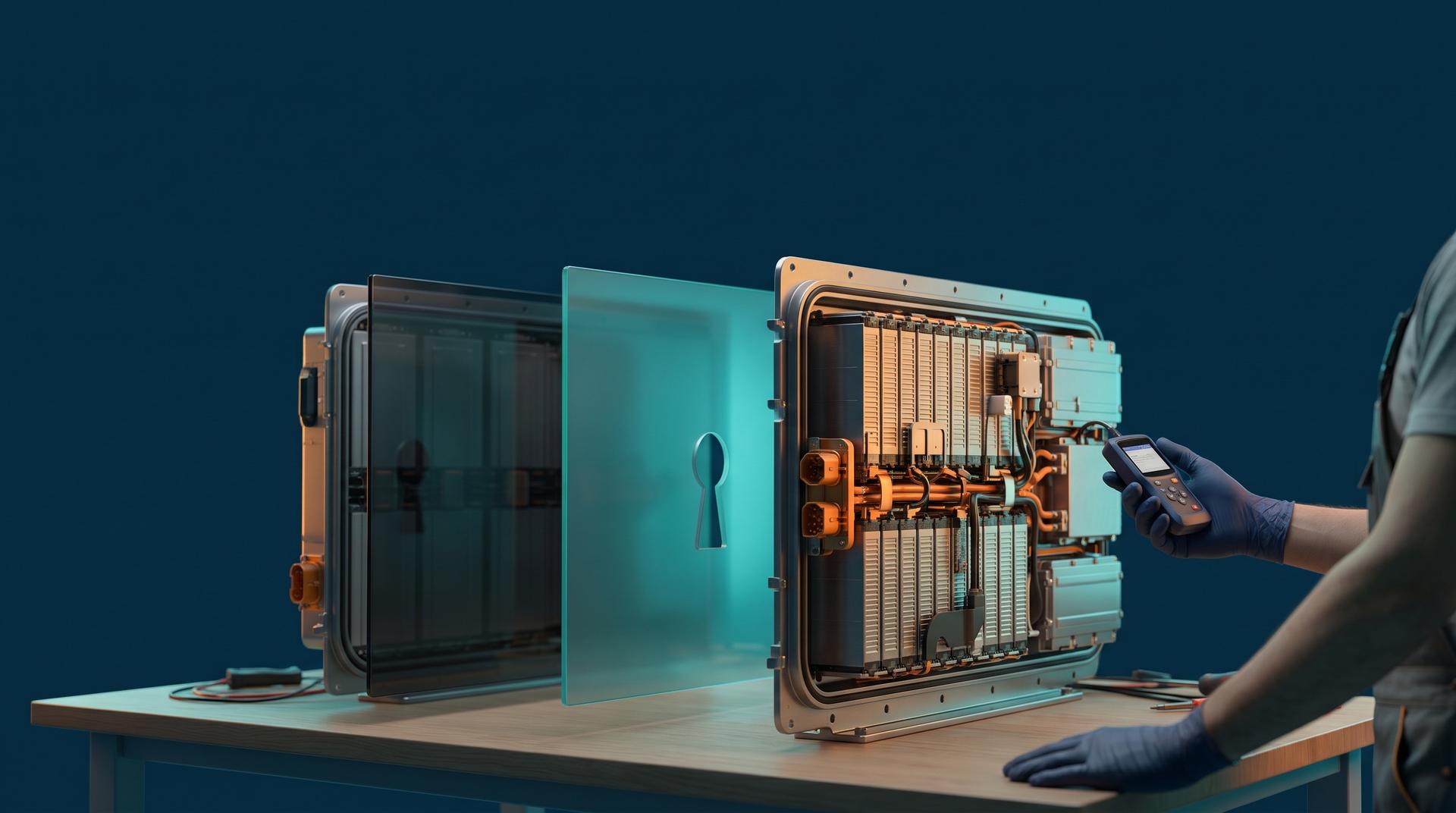
Battery Passport Access Rights: Who Can See the Restricted Data
The Commission's draft implementing regulation of 19 October 2026 says who has a legitimate interest in the restricted parts of the EU battery passport, what they may see and what they may do with it. Feedback closes on 16 November 2026. Here is what the draft says, what 38 responses ask for, and what it leaves open.
Part of every EU battery passport will be public. The rest is meant for specific people: authorities, notified bodies, the Commission, and "persons with a legitimate interest". Regulation (EU) 2023/1542 (Article 77(9)) gave the Commission until 18 August 2026 to say who those persons are, what they can see, and how far they can download, share, publish and re-use it.
The draft arrived two months late. On 19 October 2026 the Commission published a draft implementing regulation on access rights to certain parts of the battery passport (reference Ares(2026)9814179) on its Have your say portal. Feedback is open until 16 November 2026, and adoption is planned for the fourth quarter of 2026. The text is a draft: it can still change, and the document itself says it has not been adopted or endorsed by the Commission.
What is the restricted part of a battery passport?
Annex XIII of the Batteries Regulation splits the passport into four groups of information:
| Annex XIII point | What it contains | Who can see it |
|---|---|---|
| 1 | Battery model information such as manufacturer, chemistry, hazardous substances, capacity, carbon footprint and recycled content (as each obligation applies) | The public |
| 2 | Battery model: (a) detailed composition, including cathode, anode and electrolyte materials; (b) part numbers and contacts for spare parts; (c) dismantling information; (d) safety measures | Persons with a legitimate interest and the Commission |
| 3 | Test reports proving compliance | Notified bodies, market surveillance authorities and the Commission |
| 4 | Individual battery: performance and durability values, state of health, status (original, repurposed, re-used, remanufactured or waste), and data from use such as charging cycles and negative events | Persons with a legitimate interest |
The draft deals with points 2 and 4: who counts as a person with a legitimate interest for each of them.
Who can access the restricted data under the draft?
Article 1 of the draft gives four lists:
| Information | Persons with a legitimate interest (draft Article 1) |
|---|---|
| Detailed composition and dismantling information (point 2(a) and (c)) | Repairers, remanufacturers, anyone repurposing batteries, waste management operators carrying out treatment, recyclers, vocational training centres for battery repair, repurposing or remanufacturing |
| Part numbers and spare part sources (point 2(b)) | Repairers, remanufacturers, repurposers and the purchaser of the battery |
| Safety measures (point 2(d)) | Everyone in the two rows above, plus authorised end-of-life vehicle treatment facilities and treatment facilities for waste electrical and electronic equipment |
| Individual battery data (point 4) | The purchaser of the battery, and any third party acting on their behalf |
Two choices stand out. The regulation speaks of "second-life operators", and the draft names who they are: repurposers and vocational training centres. And producers or waste operators who take over responsibility for a waste battery are not on the list at all: under Article 77(7) they already have access to the full passport, so the draft does not need to name them.
What can they do with the data?
Article 2 limits the use. The restricted information can serve only to evaluate the status, residual value and further use of the battery, or to repair, prepare for re-use or repurposing, repurpose, remanufacture or recycle it, or to choose between those operations. The purchaser can also use the individual battery data to make the battery available to independent aggregators or market participants.
People with access may download the information, but they must keep it "no longer than is necessary" for those purposes. They may not share or publish it, with these exceptions:
- with emergency services, and poison centres for composition data, for health and safety;
- the purchaser may share the individual battery data with prospective buyers, market surveillance authorities and the authorities in charge of waste battery management;
- with customs authorities;
- whenever the economic operator that placed the battery on the market authorises it.
Safety measures are the exception to the whole regime. The draft (recital 3) treats them as not commercially sensitive, and the people entitled to them may use, share, publish and re-use them without restriction.
What are the 38 responses asking for?
By the morning of 13 November, 38 responses had been posted. Some of the requests:
- Insurers want to be named. The French mutual insurers' association AAM asks the Commission to recognise insurers and motor experts explicitly, because they need state of health and damage information to settle claims. The insurer Covéa also responded.
- Independent garages want equal access. BIV-Kfz, which represents 27,770 vehicle workshops in Germany, calls non-discriminatory, legally certain access to the battery passport essential for repair and diagnosis. The international body repairers' association AIRC and the parts distributor LKQ Europe also sent positions.
- Carmakers want need-to-know. BMW Group asks for clear, proportionate access with differentiated levels and purpose limitation, and comments on access for training centres, emergency services and poison centres.
- Circular operators want dismantling data open. The NGO ECOS argues that dismantling information should, as a rule, be treated as not commercially sensitive. Umicore, a recycler, asks that the change to "waste" status be recorded in the passport before the battery is shipped for treatment.
- Battery makers want safeguards. The Battery Association for Supply Chain, Japan, asks for EU-wide criteria to verify identity and eligibility, limits on downloads and retention, and protection for composition data.
- Used battery markets want clearer roles. Battery marketplaces and assessment companies point out that "purchaser" is not defined (for an electric car, it could be the owner, the lessee or a fleet operator) and that a prospective buyer cannot check state of health before buying.
The Commission will decide which of these requests reach the final text.
What does the draft leave open?
The draft says who gets access and for what purpose. It does not say how the company holding the passport recognises a person entitled to it. The project lead of the UN Transparency Protocol at UN/CEFACT made this point in a technical response (not a formal UN/CEFACT position): a manufacturer outside the EU, holding the passport of a battery now being dismantled by a recycler it has never heard of, has no stated way to decide whether that recycler qualifies.
For a company that issues battery passports, this is the practical question. A list of known partners can be managed by hand. Every repair shop, recycler and used-car buyer in the EU cannot. Whether the final act points to registers, credentials or industry schemes will shape how passport systems handle restricted access.
What battery companies can do now
- Read the draft and decide whether to respond. It is four pages. If you place LMT, industrial or electric vehicle batteries on the EU market, the 16 November deadline is your chance to comment on who sees your composition and dismantling data.
- List who already asks you for battery data. Repair partners, recyclers, fleet buyers, insurers. That list is the starting point of your access policy.
- Write safety measures for a wide audience. Under the draft, everyone entitled to them, including end-of-life vehicle and electronic waste treatment facilities, may share and publish them freely. Emergency services and treatment plants will read them, not only your partners.
- Keep the responsibility in view. Whoever fills the passport, the economic operator placing the battery on the market answers for its content. Our article on who is responsible for the EU battery passport covers the Commission's FAQ on this.
The passport itself is mandatory from 18 February 2027 for LMT batteries, industrial batteries above 2 kWh and electric vehicle batteries. What it must contain on that day is in our article on battery passport requirements for February 2027, and the state of health data that the purchaser will see is covered in our piece on e-bike battery passports. If you are comparing tools, see our page on digital product passport software for SMEs and the battery passport overview.
Frequently asked questions
Who can access the restricted information in a battery passport?
Under Regulation (EU) 2023/1542, restricted model information goes to persons with a legitimate interest and the Commission, and test reports to notified bodies, market surveillance authorities and the Commission. The Commission's draft of 19 October 2026 names repairers, remanufacturers, repurposers, waste treatment operators, recyclers and vocational training centres for the composition and dismantling data, and the purchaser of the battery for the data of the individual battery.
Is the battery passport access rights regulation already in force?
No. It is a draft implementing regulation. Feedback is open until 16 November 2026 and adoption is planned for the fourth quarter of 2026. Once adopted, it enters into force twenty days after publication in the Official Journal.
Can a recycler share battery passport data with others?
Under the draft, no, except with emergency services, customs authorities, or when the economic operator that placed the battery on the market authorises it. Safety measures are the exception: they can be shared and published freely.
Are insurers covered by the draft?
Not by name. The draft gives individual battery data to the purchaser and anyone acting on their behalf. Insurers' associations have asked the Commission to name insurers and motor experts explicitly.
When does the battery passport become mandatory?
From 18 February 2027, for LMT batteries, industrial batteries above 2 kWh and electric vehicle batteries placed on the EU market.
Sources
- European Commission, Have your say: Batteries, access rights to certain parts of the battery passport (initiative 16473, feedback 19 October to 16 November 2026), with the draft implementing regulation Ares(2026)9814179 of 19 October 2026 and the published responses
- Regulation (EU) 2023/1542 concerning batteries and waste batteries, Article 77 and Annex XIII