
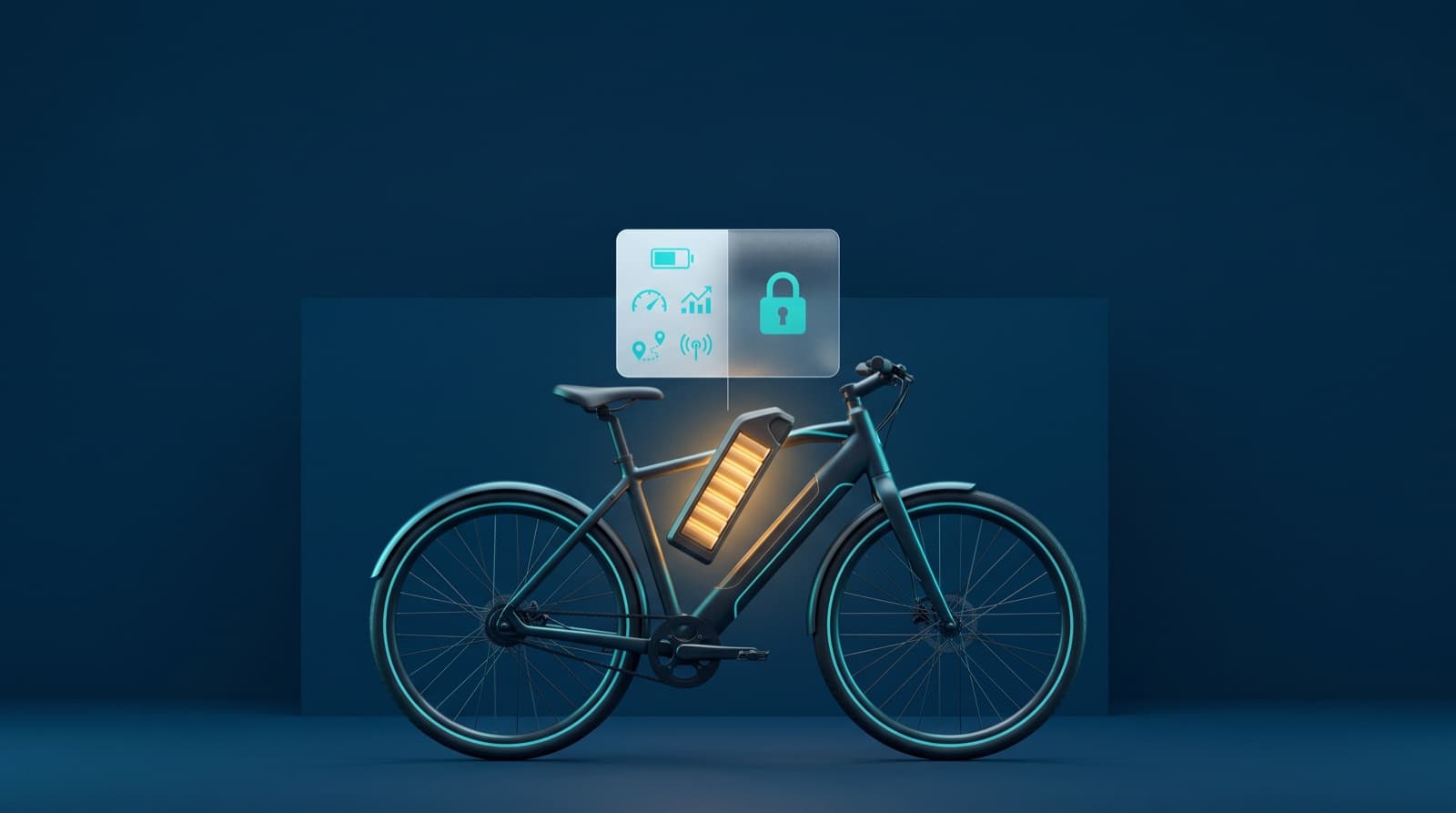
E-Bike Battery Passport: What the QR Code Shows and Who Sees State of Health
From 18 February 2027 every new e-bike battery placed on the EU market needs a battery passport. Of the 48 data points mandatory for LMT batteries, 30 are public. State of health is not one of them. What a scan shows, who gets the restricted data, and what a used e-bike buyer can ask for instead.
Two cycling outlets asked the same question this week. TodoMountainBike (1 November 2026) and Electrek (2 November 2026) looked at the EU battery passport from the side of the rider: will the QR code on an e-bike battery tell a second hand buyer how worn the battery is?
Both articles conclude that it is not certain. The regulation and the Commission's guidance give a clearer answer. The passport makes a lot of information public, but the state of health of an individual battery is not part of it. For a used e-bike, the route to that data is the battery management system, and it opens to the person who has bought the battery.
Does an e-bike battery need a battery passport?
Yes. An e-bike battery is an LMT battery, which Regulation (EU) 2023/1542 defines as a battery that is sealed, weighs 25 kg or less and is designed to power wheeled vehicles that can run on an electric motor alone or on a combination of motor and human power (Article 3(1), point 11). That covers e-bikes, e-MTBs and e-scooters.
Article 77(1) reads: "From 18 February 2027 each LMT battery, each industrial battery with a capacity greater than 2 kWh and each electric vehicle battery placed on the market or put into service shall have an electronic record ('battery passport')." The 2 kWh threshold belongs to industrial batteries only. Every LMT battery placed on the market or put into service from that date needs a passport, whatever its capacity.
What does an e-bike battery passport show to the public?
The European Commission's guidance document Digital Batteries Passport: data points by category (version 3.2, 19 October 2026) lists 71 data points and marks each one per battery category and access level. From February 2027, 48 are mandatory for LMT batteries. Of those 48, 30 are public:
- identity: unique identifier, manufacturer and its address, battery category, model, place and date of manufacture
- basic characteristics: weight, capacity, chemistry, minimum, nominal and maximum voltage, original power capability and power limits
- performance and durability of the model: expected lifetime in cycles and the reference test, initial round trip efficiency and at 50% of cycle life, internal resistance, charge C-rate, temperature range
- materials and safety: hazardous substances, usable extinguishing agent, critical raw materials, share of renewable content
- compliance and end of life: markings, the EU declaration of conformity, information on prevention and management of waste batteries
Anyone who scans the QR code can read these values. They describe the battery model as it left the factory.
What stays restricted in the passport
The other 18 mandatory data points are not public:
| Data points (guidance v3.2) | What they cover | Who can access them |
|---|---|---|
| 46 to 49 | Detailed composition, part numbers and sources for spare parts, dismantling information, safety measures | Persons with a legitimate interest, notified bodies, market surveillance authorities and the Commission |
| 50 | Test reports proving compliance | Notified bodies, market surveillance authorities and the Commission |
| 52 to 56, 59 and 60 | Capacity fade, power, power fade, internal resistance and its increase, expected lifetime in cycles and in years under reference conditions | Persons with a legitimate interest (individual battery) |
| 62 to 66 | State of health under Article 14: remaining capacity, remaining power capability, remaining round trip efficiency, evolution of self discharge, ohmic resistance | Persons with a legitimate interest (individual battery) |
| 67 | Status of the battery: original, repurposed, re-used, remanufactured or waste | Persons with a legitimate interest (individual battery) |
Four more points apply as soon as the battery starts to be used, and they are restricted too: number of charge and discharge cycles (68), negative events such as accidents (69), operating conditions including temperature (70) and state of charge (71).
Who counts as a person with a legitimate interest?
Article 77(2) ties the restricted information to two purposes. The first is dismantling, safety and detailed composition, where access must be essential for repairers, remanufacturers, second life operators and recyclers to do their work. The second, for individual batteries, is the purchaser making the battery available to independent energy aggregators or energy market participants.
Who exactly counts is being decided now. The Commission has published a draft implementing regulation on access rights to certain parts of the battery passport. Its feedback period runs from 19 October to 16 November 2026, and adoption is planned for the fourth quarter of 2026. Repair shops, second life operators and recyclers who work with e-bike batteries can still comment.
Can a used e-bike buyer see the battery's state of health?
Not through the public passport. The route that already applies goes through the battery management system.
Since 18 August 2024, Article 14(1) requires the battery management system of LMT batteries, stationary storage systems and electric vehicle batteries to contain up to date data on the parameters in Annex VII. For LMT batteries these are the remaining capacity, where possible the remaining power capability and round trip efficiency, the evolution of self discharge and, where possible, the ohmic resistance, plus the data for expected lifetime such as energy throughput and harmful events.
Article 14(2) gives read-only access to that data, through the BMS, to "the natural or legal person who has legally purchased the battery", or to a third party acting on their behalf, for purposes that include "evaluating the residual value or remaining lifetime of the battery".
In practice:
- The right belongs to whoever has bought the battery. The current owner of a used e-bike has it; a person still deciding whether to buy does not.
- Before buying, ask the seller for a reading of the BMS data. The seller, as owner, is entitled to it.
- After buying, the new owner has the same right of read-only access.
- Use the QR code for what it does well: confirming the model, the chemistry and the expected lifetime in cycles that the manufacturer declared.
Who is responsible for the passport of an e-bike made outside the EU?
The passport is attached to the battery, and the duty falls on the economic operator that places the battery on the EU market. Under Article 77(3) and (4), that operator attributes the unique identifier behind the QR code and keeps the information "accurate, complete and up to date". For an e-bike brand based outside the EU that sells through an EU importer, the importer is usually that operator: the Commission's FAQ on the battery passport explains the cases. We went through them in who is responsible for the EU battery passport.
What e-bike brands and importers can do before 18 February 2027
- List the battery models you will place on the EU market from 18 February 2027, and who places each one on the market.
- Plan one unique identifier and one QR code per battery, as Article 77(3) requires.
- Map each model against the 48 mandatory LMT data points of guidance version 3.2, and mark which are public and which are restricted. Our guide to how many battery passport data points are mandatory walks through the list.
- Check what your BMS exports: state of health, cycles and the Annex VII parameters, and how an owner can read them today under Article 14.
- Decide how restricted data reaches repairers and recyclers, and follow the access rights act once it is adopted.
Our earlier article on the first e-bike battery passports covers the deadline and the content of the LMT passport in more detail.
Hoken Pass is digital product passport software for SMEs with a battery template for EV, LMT and industrial batteries. Each section of the template carries the access level of the guidance: the public page shows the public data points, and restricted sections open only through a signed link sent to the emails the brand authorises. Each published passport also gets a qualified eIDAS timestamp from InfoCert. For the full picture of the battery rules, see our EU battery passport page.
Frequently asked questions
Does an e-bike battery need a battery passport?
Yes. E-bike batteries are LMT batteries under Article 3(1), point 11 of Regulation (EU) 2023/1542, and Article 77(1) requires a passport for each LMT battery placed on the market or put into service from 18 February 2027. There is no capacity threshold for LMT batteries; the 2 kWh limit applies to industrial batteries.
Is the state of health of an e-bike battery public in the battery passport?
No. Under the Commission's guidance (version 3.2, 19 October 2026), the state of health data points (62 to 66) are restricted to persons with a legitimate interest. The public part covers the model data, including expected lifetime in cycles and round trip efficiency.
How many data points are mandatory for an e-bike battery passport?
48 of the 71 data points are mandatory for LMT batteries from February 2027, according to guidance version 3.2. 30 are public, 17 are restricted to persons with a legitimate interest (four of them also to authorities) and one, the test reports, is only for notified bodies, market surveillance authorities and the Commission.
Can I check the battery health of a used e-bike before buying it?
Not through the public passport. Article 14 gives read-only access to the state of health data in the battery management system to the person who has legally purchased the battery. Before buying, ask the seller, who owns the battery, for a reading of that data.
Who decides who has a legitimate interest in battery passport data?
The European Commission, through an implementing regulation on access rights. The draft was open for feedback from 19 October to 16 November 2026, with adoption planned for the fourth quarter of 2026.
Sources
- Regulation (EU) 2023/1542 on batteries and waste batteries, Articles 3, 14 and 77 and Annexes VII and XIII (EUR-Lex)
- European Commission: Guidance Document, Digital Batteries Passport, data points by category, version 3.2, 19 October 2026
- European Commission, Have your say: Batteries, access rights to certain parts of the battery passport
- European Commission: EU Digital Product Passport FAQ for batteries
- Electrek: How Europe's battery passport could have a big impact on US e-bikes (2/11/2026)
- TodoMountainBike: Europe's 2027 Battery Passport Rules Could Change How E-MTB Batteries Are Tracked, Repaired and Resold in the US (1/11/2026)
Start free with 3 passports: hokenpass.com.