Emuārs
Ieskati, apmācības un aktualitātes par Digital Product Passports.

Digital Product Passport Software for Clothing Makers: Start With the Rules That Already Apply
The textile DPP delegated act is planned for 2027, but two EU rules already ask clothing brands for proof: the ban on generic green claims and the ban on destroying unsold apparel. What they require, what they share with the DPP, and what to look for in DPP software for a small clothing brand.

The EU DPP Registry Cannot Register Battery Passports Yet. What to Do Before February 2027
The Commission's Registry guide says battery passport registration is not available yet, because the battery semantic catalogue is still missing. The deadline has not moved. What the FAQ settles, why TÜV SÜD talks about an assurance gap, and the work you can finish now.

eBike Batteries Need a Passport from 18 February 2027: the TENWAYS Case
TENWAYS with Minespider started issuing battery passports for eBike batteries ahead of the LMT deadline. What the passport must contain, why the QR is the easy part, and the SME checklist.

Textile DPP Left the Lab: What Goldwin and Dolce & Gabbana Prove
Two textile DPP proofs in one week: Dolce & Gabbana runs a commercial passport with DataSpira, Goldwin tags upcycled uniforms. Timeline, data model, and what SMEs should do now.

Pakistan Textile Suppliers Face the EU Textile DPP: What SMEs Need
The EU circular fashion shift pushes Pakistan textile suppliers toward traceability and certification. DPP requirements land in Q4 2027: what small mills need now, from EPR timelines to affordable passport tools.

EU Battery Passport 2027: Voluntary Standards Mean Fewer Checks
The EU published harmonised DPP standards and switched on the Registry. For SMEs the key point: voluntary CEN/CENELEC standards give presumption of conformity, which means fewer verifications and lower cost before the 18 February 2027 battery deadline.

Foundation Before QR: Battery and Panipat DPP Readiness
Battery passports from 18 Feb 2027 and Panipat verified circularity show the same lesson: build a verifiable DPP foundation before any QR, with GS1 and eIDAS.

Battery Passport Compliance Starts Before the QR: Foundation Guide
Carbmee frames battery passport compliance as 80+ fields, not a QR. Learn the five foundation checks, the guidance data points and the Battery Pass clusters before 18 Feb 2027.
Digital Product Passport Data Gaps: What SMEs Must Fix Before the EU DPP Registry
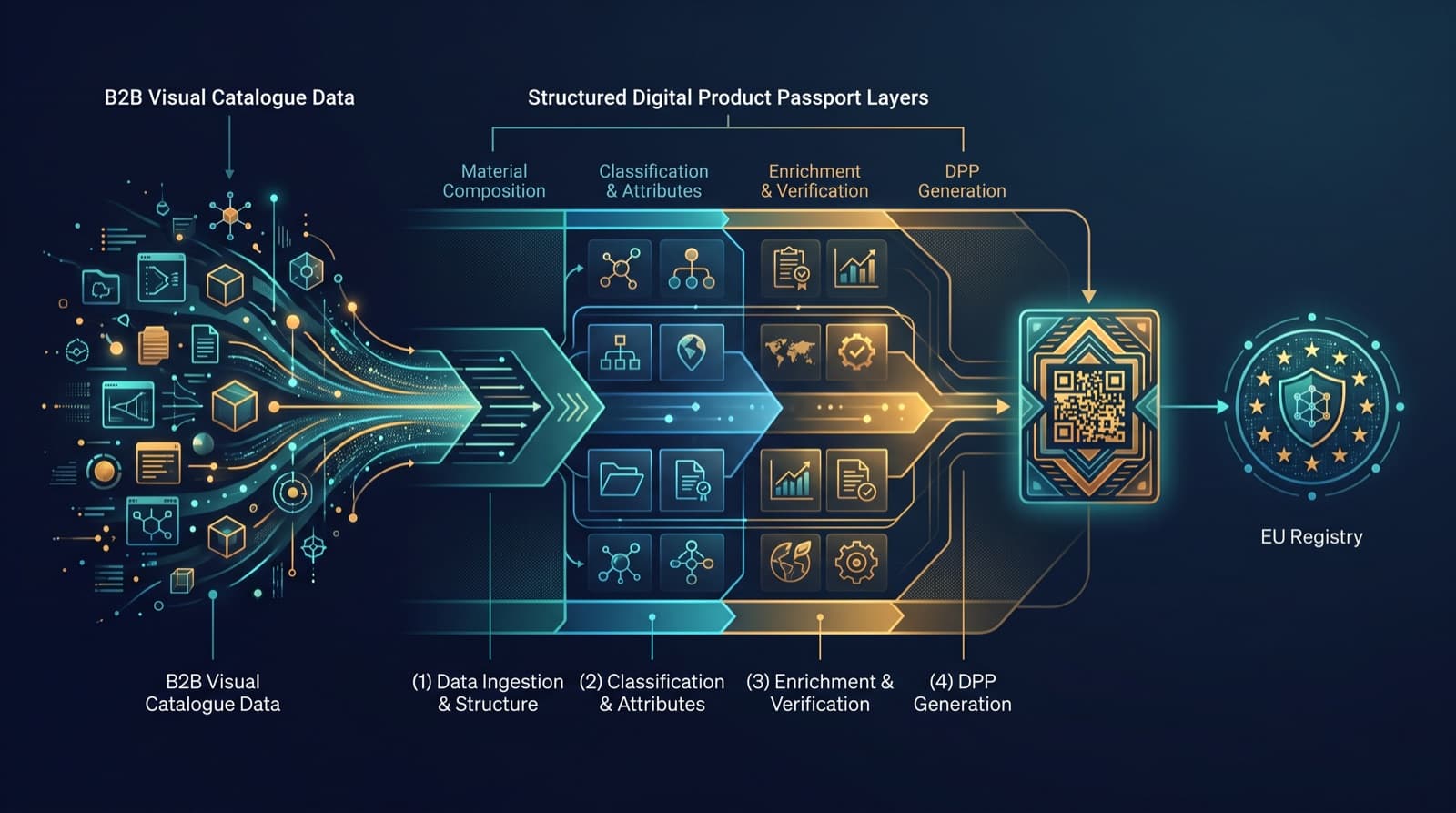
Most DPPs fail not at the QR but at the catalogue. Learn the JRC essential vs recommended tiers and how AICA Atlas fixes classification before Hoken Pass generates your GS1 QR.

Battery Passports and the Second-Life Gap: What to Fix Before 18 February 2027
Battery passports become mandatory on 18 February 2027, but the batteries that will supply second-life storage for the next decade are already on the road without one. This guide explains the three gaps that could push good batteries to premature recycling and how to make second-life data verifiable.

What a Digital Product Passport with eIDAS Timestamp and Blockchain Really Needs
The EU does not require blockchain for a Digital Product Passport. It requires authentic, tamper evident, verifiable data. Here is how a qualified eIDAS timestamp and a blockchain anchor split that job, after Regulation 2026/1778 and the new harmonised standards.

DeSL Built the DPP Inside PLM. Why SMEs Should Build It Outside
DeSL launched DPP software natively on PLM for fashion brands. For SMEs without enterprise PLM, a DPP-first, registry-ready approach with eIDAS and blockchain is the leaner path.

A QR Code Is Not a Digital Product Passport: What Textile Exporters Must Build by 2028
UKFT confirms a QR code alone is not a DPP. For textiles, the passport is structured ESPR data. Here is what to build before 2028.

EU Battery Passports: Can Your Suppliers Provide Their Data?
EU battery passports become mandatory in February 2027. Most of the required data does not live in your systems. Here is what SME manufacturers need to do now.

The association asks the DPP to slow down. The dates are not moving anyway
The VDMA wants the EU to slow down on the digital product passport. Battery passport deadlines do not move because of a policy debate, so what does change for an SME in 2026?

Battery Passport Data Points: How Many Are Actually Mandatory in February 2027
The battery passport has 71 data points. That sentence is true and almost useless on its own, because the number of points you must actually fill in depends on what kind of battery you make.

EU Battery Passport Implementation: The New Commission Guidance and What to Do Before February 2027
The European Commission's August 2026 guidance maps all 71 battery passport data points by category. Here is what it requires, what the new DPP Registry means, what DENSO's real-world validation revealed, and how SMEs can prepare before 18 February 2027.

Gartner validated the DPP market. The battery passport deadline is still coming
Gartner now publishes an Emerging Market Quadrant for Digital Product Passport, and MarketsandMarkets expects the battery passport market to grow 15-fold by 2035. What both signals mean for EU SMEs facing a February 2027 deadline.

Battery Passport Deadline: 6 Months to Compliance
The EU Battery Passport becomes mandatory on 18 February 2027. Here's what ~100 data points per battery means for SMEs, and how to start building your Digital Product Passport now.

Digital Product Passports Are Leaving the Lab: Real-World Pilots to Watch
Two real-world pilots this week — a Glasgow remanufacturing trial and fabric-level denim testing — show the Digital Product Passport moving from concept to production line. What it means for brands.
PPWR Technical File (Annex VII): What Packaging Companies Must Prepare Before August 12, 2026
Quick answer: PPWR Annex VII technical file Every packaging manufacturer must compile a technical file (Annex VII of EU Regulation 2025/40) before signing the Declaration of Conformity. It contains the evidence that your packaging meets PPWR requirements on minimisation, recyclability, recycled content, and labelling. No notified body is required — this is Module A (internal production control). Retention: 5 years for single-use packaging, 10 years for reusable. Market surveillance authorities can demand access within 10 days. Deadline: 12 August 2026.
PPWR Penalties & Non-Compliance: What Happens After August 12, 2026
PPWR quick answer: From 12 August 2026, packaging placed on the EU market without a valid Declaration of Conformity (DoC) and supporting technical documentation can be prohibited, withdrawn from sale, or blocked at customs. Regulation (EU) 2025/40 requires Member States to set penalties that are effective, proportionate, and dissuasive — with no EU-wide cap on fines. The Packaging and Packaging Waste Regulation — Regulation (EU) 2025/40 — entered into force on 11 February 2025 and applies from 12 August 2026. That date is not a transition deadline: it is when market surveillance authorities across the EU acquire full enforcement powers over packaging compliance. For manufacturers, importers, and distributors placing packaging on the EU market, understanding exactly what non-compliance triggers — and how fast consequences materialise — is now a business continuity question.
PPWR Declaration of Conformity: Requirements for Packaging Manufacturers 2026
From 12 August 2026, every packaging item placed on the EU market under Regulation (EU) 2025/40 needs an EU Declaration of Conformity signed by the manufacturer. The document is short, often a single page, but it sits on top of a technical file that can run to dozens of pages per SKU. Get the structure wrong and the declaration is legally invalid, the packaging cannot be marketed, and the manufacturer carries the liability. This guide breaks down what goes into the DoC, what backs it up in the technical file, and how to scale the workflow across thousands of references.