
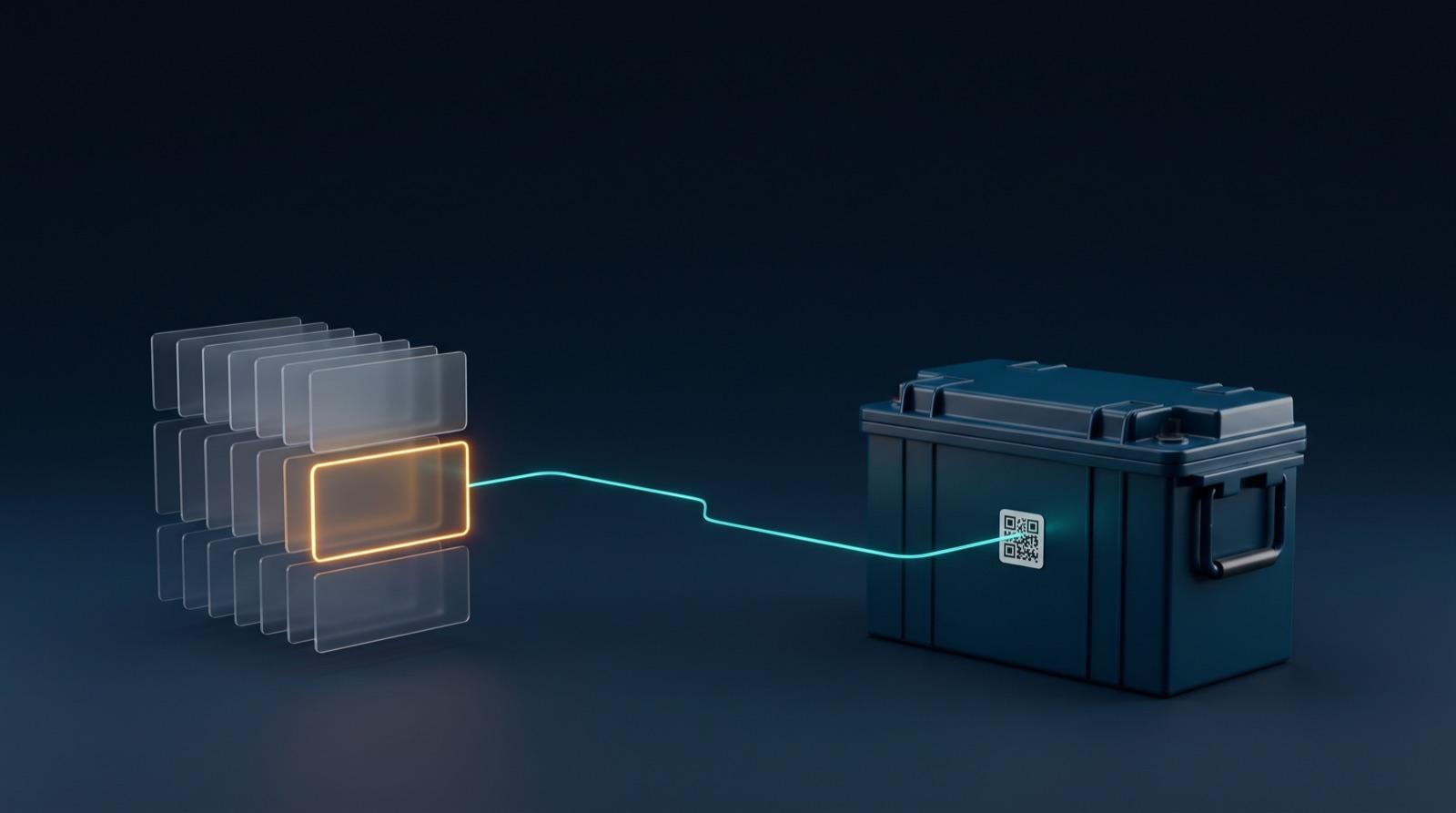
EU DPP Registry: How Battery Passport Registration Will Be Checked
The Commission has published the technical guides for the EU DPP Registry. When you register a battery passport, the Registry reads the content at your identifier and accepts only JSON in the Commission's schema. What that means for a small battery maker, what it can skip, and what to check before 18 February 2027.
On 16 November 2026 the European Commission announced technical guidance for the Digital Product Passport Registry. The Registry is the EU index that stores the unique identifier of each passport and some registration data, while the passport itself stays with the company that issues it. The new documents explain how systems connect to it and, more important for battery makers, what the Registry checks when a passport is registered.
In October we wrote that the Registry could not register battery passports yet, because the battery data catalogue was missing. That catalogue is now public. This article covers what the guides say, what we saw when we ran test registrations, and what a small manufacturer can safely leave to others.
What the Commission published
The documents are on the Commission's Resources and documentation page, section "DPP Registry technical guidelines". All six are dated 30 October 2026:
| Document | What it covers | Needed by a small battery maker that registers by hand? |
|---|---|---|
| API Integration Guide for Economic Operators | Connecting your systems to the Registry APIs: authentication, registration, errors | Read the validation part; the rest is for integrators |
| OpenAPI Specifications | The machine definition of the Registry APIs | No |
| Semantic Data Guide | How passport data is structured: taxonomies, validation schemas, SHACL shapes | Yes, for whoever prepares the data |
| Semantic Data Artifacts | The files themselves: JSON schemas, SHACL shapes, JSON-LD contexts, vocabularies | Yes, through your software |
| Service Account Technical Integration Guide | Machine-to-machine access with private_key_jwt | No |
| Self-Hosted Authentication Guide | Checking who may open restricted data, for companies that host passports on their own servers | Only if you host passports yourself |
The page notes that the testing features described in these guides "will become available gradually before the Registry goes live".
How does the EU DPP Registry check a battery passport?
Registering a passport is more than typing its identifier into a form. The API Integration Guide says that when a passport is submitted, the Registry "shall read the digital product passport content and validate it". The content has to be reachable at that moment, and the Registry does not keep a copy of what it reads.
We tested this on 17 November 2026 on the Registry's Acceptance (test) environment, with a verified organisation. When we submitted a registration, the Registry fetched our identifier with a plain GET, without asking for a specific format (Accept: */*), and it followed our redirect.
Then we asked the Commission's DPP helpdesk what it expects back. Their written answer of 17 November: the Registry does not set an Accept header, and "only JSON responses are accepted, though; anything else is rejected."
This matters because many passport links today open a web page, which is what a person scanning the QR code wants to see and what the Registry will reject. A battery passport whose identifier answers only with HTML will fail the check when validation is switched on.
What the battery passport JSON must look like
The JSON is not free form. The Semantic Data Artifacts (version 1.0.0) define a compact JSON object with:
- core properties every passport has, such as the passport identifier, the unique product identifier, the granularity (model, batch or item), the status and the date of the last update;
- battery properties split by access level: a public part and three restricted levels for composition and dismantling, test results, and the status and use of the individual battery;
- extra properties for each category: electric vehicle, light means of transport and industrial batteries.
The public part of the battery schema has 29 properties, and 25 of them are mandatory. Units and coded values, such as the battery category or chemistry, are written as links to the Commission's vocabularies, not as free text. Texts that can be in several languages carry a language tag.
The restricted levels follow the access rules of the Batteries Regulation. Restricted levels open only to authorised readers; the Self-Hosted Authentication Guide describes how companies that host their own passports check who is asking.
Do you need the DPP Registry API?
Most small manufacturers do not. The API, with service accounts and private_key_jwt authentication, is meant for systems that register passports automatically, often at volume. A company can also register its passports in the Registry portal, signed in with its own EU Login. On the test portal the registration form asks for the granularity, the unique product identifier and, optionally, batch and model identifiers.
What you cannot skip is the content check. Whether you register through the portal or the API, the Registry reads your identifier and validates what it finds there.
When does validation start?
Not yet. When we registered test passports on 17 November, both attempts ended with "Semantic validation failed due to its unavailability", including one using the Commission's own example file. The helpdesk confirmed that semantic validation "is not yet operational" and described the current plan: first a preliminary version on the Acceptance environment, with checks from the user interface, then a test version of the APIs on Acceptance in December, then production, "currently targeted for the end of January". The Commission can still move these dates.
The legal date has not changed. Under Article 77 of Regulation (EU) 2023/1542, the battery passport applies from 18 February 2027 to EV batteries, LMT batteries and industrial batteries above 2 kWh. The Commission's news item says operators can prepare to register "from 18 February 2026": the Regulation and the Commission's own DPP timeline both say 2027.
The same timeline lists the fourth Commission webinar on the battery passport, online, on 26 November 2026.
What we changed in Hoken Pass
After reading the schema and seeing how the Registry reads identifiers, we changed how our identifiers answer. Since 17 November, a battery passport identifier created in Hoken Pass gives JSON in the Commission's battery schema to any request that does not ask for a web page, and keeps showing the passport page to people who scan the QR code. The editor compares the data with the schema and lists what is missing or cannot be converted, so you see the gaps before the Registry does. It warns and never blocks publication. The JSON file whose hash we anchor with a qualified timestamp does not change.
If you are choosing a tool, this is one of the questions to ask any digital product passport software for SMEs: what does my passport link return to a machine? More on our approach on the battery passport page.
What to do before 18 February 2027
- Test your passport link without a browser. Run
curl -i <your identifier>and look at theContent-Type. If you gettext/html, your registration will fail once validation is running. - Check your data against the 25 mandatory public properties. Units, battery category and chemistry are the usual gaps, because the schema wants vocabulary values, not your own labels. Our earlier article on what can wait until after February 2027 lists the data points due on day one.
- Decide who registers. Registering by hand in the portal with your EU Login, or an integration through the API. For most SMEs the portal is enough.
- Get your EU Login and operator verification done early. The Registry has to know who you are before you can register anything. Our guide on who is responsible for the battery passport explains which company that is.
- Re-test when the Acceptance validator is back. The helpdesk's plan points to December for the test APIs.
Frequently asked questions
Will a QR code that opens a web page pass the EU DPP Registry?
Not on its own. The DPP helpdesk told us on 17 November 2026 that the Registry accepts only JSON responses and rejects anything else. The same identifier can still show a page to people: the server decides from the request whether to send the page or the JSON.
Do I need the DPP Registry API to register battery passports?
No. The API and service accounts are for automated registration. A company can register passports in the Registry portal with its own EU Login. In both cases the Registry reads and validates the content at the identifier.
Is semantic validation already running in the EU DPP Registry?
Not as of 17 November 2026. The helpdesk's current plan is a preview on the test environment, test APIs in December and production targeted for the end of January 2027.
When do battery passports become mandatory?
From 18 February 2027 for EV batteries, LMT batteries and industrial batteries above 2 kWh, under Article 77 of Regulation (EU) 2023/1542.
Does the Registry store my passport data?
No. It stores the identifier and registration data. The guide says it reads the passport content to validate it and does not keep what it reads. The passport stays with the company that issues it.
Sources
- European Commission, Commission publishes technical guidance to support implementation of the Digital Product Passport Registry (16/11/2026)
- European Commission, Digital Product Passport: Resources and documentation (DPP Registry technical guidelines, 30/10/2026)
- European Commission, Digital Product Passport (timeline and webinars)
- Regulation (EU) 2023/1542 on batteries and waste batteries, Article 77
- European Commission DPP Helpdesk, written reply to Hoken Tech (17/11/2026)
Start free: https://www.hokenpass.com